
Showing posts with label mandala. Show all posts
Showing posts with label mandala. Show all posts
Monday, August 8, 2011
Mandala Monday - Elemental Mandala


Monday, June 20, 2011
Mandala Monday - Word Mandalas
A word-mandala brings together two techniques that C. G. Jung used to study the unconscious mind: word association and mandala drawings. Jung conceptualizes mandalas “patterns of order which, like a psychological ’view finder’ … superimposed on the psychic chaos so that each content falls into place and the weltering confusion is held together by the protective circle.” The “sacred circle” of the mandala helps the artist bring order and find patterns in the chaotic flow of the unconscious mind.
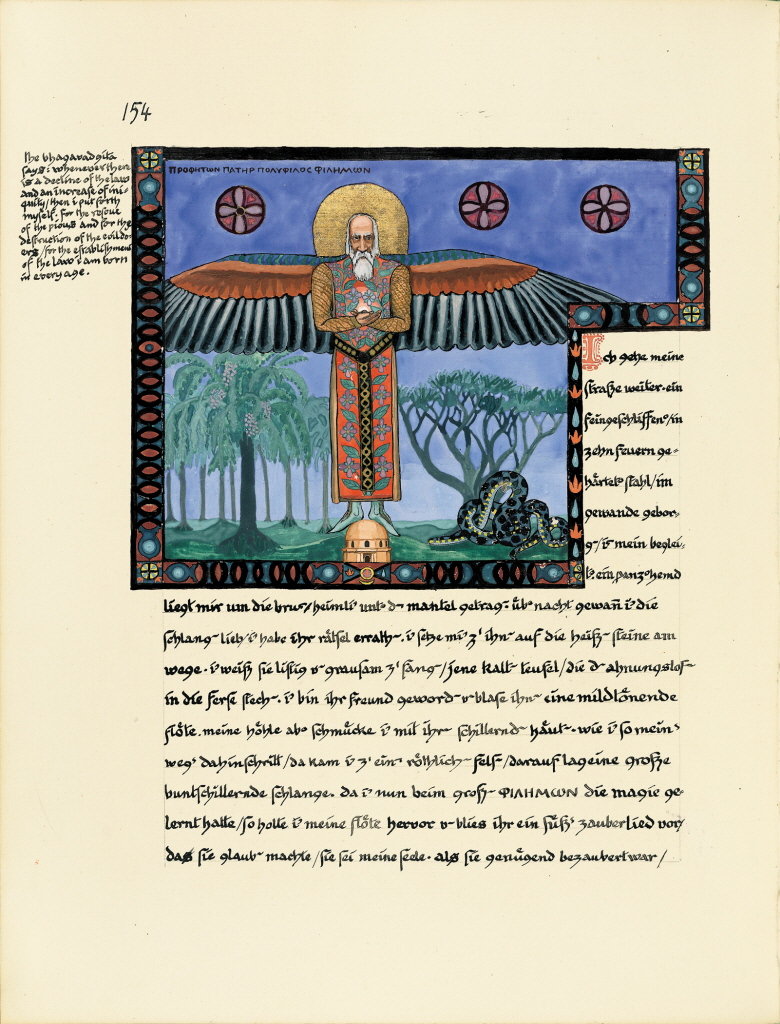 |
| An archetypal illustration from Jung's Red Book. |
Mandalas are traditionally geometric drawings, but they can also be created with words.
In Memories, Dreams, and Reflections Jung notes that during word-association sessions patients often drew blanks at certain words. The patient might instantly respond “Frisbee” to “dog,” while “cat” receives a long silence. Jung links these silences to Frued’s concept of repression, but they have positive implications too. Certain words serve as keystones for larger ideas. So if you begin with Word A, the words will connect to Word A for a while, but when another keystone word appears, the words begin to connect with it instead. If you hunt through a page of word-associations, you’ll probably pick out the ‘big ideas’, the keystones that mark the flow of thoughts. Jung called them Complexes. So while the stream of words might appear chaotic, they map out patterns similar to the circles, squares, and crosses of hand-drawn mandalas. What the mandala maps thoughts kinesthetically, word associations map linguistically.
Or you can play with both sides of the brain and create a word-mandala that combines word association and mandala drawing.
- Begin with either the word-association or the mandala. But first take a moment to meditate on your central thought. I chose Shakti, the Hindu goddess who awakens love and creativity.
- Create a mandala using the technique of your choice. I repeat my central thought as a mantra when I draw the dot in the center of my mandala. Keep it in mind as you create both the drawn and written portions of your mandala
- After you've sketched the outline of your mandala drawing, begin a page of word association beginning with your central thought. Write slowly and mindfully. Let your mind wander freely from one word to the next.
- Next, study your word-association page and begin picking out the keystone ideas. Study your drawn-mandala to get a rough idea of how many words you need and how they’ll interconnect in the drawing.
My word-association began as:
Shakti: Namaste ~ Pray ~ Play ~ Dance ~ Flow ~ Grow ~ Seeds ~ Beads ~ Tangled twine ~ Divine ~ Stars ~ Galaxy ~ Mind ~ Vibrant ~ Rainbow ~ Crescent ~ Crescendo ~ Sound ~ Profound ~ Inspiration ~ Liberation ~ Revolution ~ Rise like lions ~ Slumber ~ Surrender ~ Submerge ~ Purified ~ Sanctuary ~ January ~ Stillness ~ Center ~ Spiral ~ Dancing ~ Flame ~ Never break the chain ~ Entwine ~ Sublime ~ Mystery ~ History ~ Storyteller ~ Grandmother ~ Spider web ~ Thread ~ Blood ~ Journey ~ Descent ~ Transcend ~ Living Light ~ Illuminate ~Poetry ~ Word Hoard ~ Dragon ~ Ancient ~ Prophecy ~ Raven ~ Trickster ~ Coyote ~ Horizon ~ Shadow ~ Glimmer ~ Glitter ~ Joy ~ Whirling ~ Rumi ~ Library ~ Treasure ~
And became:
Shakti: Grow ~ Vibrant ~ Inspiration ~ Liberation ~ Sanctuary ~ Stillness ~ Center ~ Sublime ~ Transcend ~ Storyteller ~ Journey ~
- Finally, begin placing keystone words inside the mandala outline. Add colors, symbols, patterns, and other decorations. I chose to add some lines of poetry, because I realized my association of lions with rebellion originated from a Percy Bysshe Shelley's "The Mask of Anarchy".

Monday, June 13, 2011
Mandala Monday - Shadows and Sight

In the center of this mandala by Yen Chua, the mediator dissolves into bliss. Beyond the shadow of the ego, the eyes of the mind open and reveal universal harmony.
Monday, May 30, 2011
Mandala Monday - A Memorial Flower

"Within every seed a flower sleeps. Within every mind lingers a dream."
I’d like to take a moment this Memorial Day to dedicate a mandala to the dreamers, laborers, parents, and soldiers who have given their lives in service. Memorial Day traditionally honors veterans, but I believe there is something equally noble in the sacrifices of everyday men and women. This mandala honors the father who surrenders his personal aspirations and works two jobs to buy his children a foothold in the American dream. This mandala celebrates the environmental activist sowing seeds in abandoned parking lots. May their spirit of generosity and perseverance inform the future of our nation. Blessed be.
Monday, May 9, 2011
Mandala Monday - Hooping Mandala

We dance round a ring and suppose,
but the Secret sits in the middle and knows.
-Robert Frost
 In mandala mythology, the circle represents the universe. A single dot in the circle's center symbolizes the stillness at the heart of Creation. Hoopdance is a beautiful, moving mandala. When a hooper whirls a hoop around her body, she becomes the axis of the cosmos. The circle of the hoop forms rings that mirror the levels of consciousness that pull the dancer toward or away from the sacred center. Hooping on the core, for example, draws the circle in. Off-body passes and moves like the helicopter expand the circle to embrace the outer-world. The dancer's hands and legs form smaller circles as he whirls, steps, and dances. These mandala-patterns become tangible in LED and fire-hoop photography. The steams of light map the journey of the hoop through space and the dancer through the act of creation.

Twirling round with this familiar parable
spinning, weaving round each new experience.
Recognize this as a holy gift
and celebrate this chance to be alive and breathing.
-Tool

Monday, July 26, 2010
Mandala Monday # 2

Monday, June 7, 2010
Mandala Monday #1
One of my summer goals is to create and share a mandala every Monday. These geometric patterns, inspired by ancient Tibetan artwork, are an act of conscious creation. They clear the mind and reaffirm cosmic order, unity, and transformation. For me personally they are meditative tools that resurface in my life when the desire to doodle momentarily prevaials over the need to write lists.
Today's digital mandala was created by Lori Beaty. According to Beaty, "Meditation on this mandala promotes clarity and ease of movement to and from different levels of consciousness. It is, in essence, a cosmograph of the path to enlightenment."

Today's digital mandala was created by Lori Beaty. According to Beaty, "Meditation on this mandala promotes clarity and ease of movement to and from different levels of consciousness. It is, in essence, a cosmograph of the path to enlightenment."

Subscribe to:
Posts (Atom)